
- Home
- Graduate Programs
- Masters in Higher Education
- Master's in Higher Education
Become a leader who inspires the next generation of students
Geneva College’s Master of Arts in Higher Education program prepares future leaders with a Christian view of life, emphasizing the integration of faith and learning. For over 30 years, this program has been the foundation for Christian Higher Education, fostering competent, creative, and purposeful professionals who view higher education as a sphere of God's redemptive activity. Students explore the theological, philosophical, historical, and sociological foundations of the field, and gain professional skills through contextualized learning experiences. Graduates learn to impact student lives holistically and are prepared for diverse roles within higher education. To contact the Geneva Graduate Admissions staff, email gradadmissions@geneva.edu or call 724-847-6505.
Master's in Higher EducationMaster's in Higher EducationDiscover a vision that redefines learning and work in higher education.
Program Overview
The Master of Arts in Higher Education program at Geneva College offers a foundational approach to learning about higher education and building capacity for professional practice in the field. The program is a 36-credit program. All students take the Foundations Core (33 credits) and one Elective (3 credits). Contextualized learning is an important facet of the program. Students are required to engage in a minimum of 600 hours of related field experience during their graduate studies.
Program Delivery Methods
The institute model is an online program with a low residency requirement, designed with working professionals in mind. Students in this low residency model take one-week, on-campus courses via our Summer Institute (June) and Winter Institute (January), and take online course during the academic year.
Cohort students take on-campus classes each semester, typically on Tuesday and Thursday evenings. In addition, students participate in Summer Institute (June) between year one and year two of the program and in each Winter Institute (January) leading into the spring semester.
This part-time model offers students the opportunity to complete the degree by choosing courses at their own pace as they are offered, until all program requirements are fulfilled within a maximum of seven years.
Summer and Winter Institutes
As an essential part of the MAHE program, we offer unique week-long intensive experiences, called Institutes. Summer and Winter Institutes are designed for students to interact in-person with classmates in Geneva's Christ-centered academic community while completing required coursework. The institute fosters meaningful connections through shared meals, challenging discussions, and a supportive learning community. Depending on the desired delivery method, students will participate in a summer or winter institute as the program requires.
The goal is that our students would view their professional practice with people and view the institutions of higher learning where they work as spheres of God’s redemptive activity.

Certificate in Higher Education and Student Development Program
The purpose of the Certificate in Higher Education and Student Development program at Geneva College is to cultivate a vision for higher education that is rooted in a Christian view of life. This certificate program examines the contexts of its theological, philosophical, historical, and sociological foundations.
The Certificate in Higher Education and Student Development program is designed as a 12-credit stackable supplement into one of our partner institution’s approved master’s degree programs. Students from partner institutions receive a 33% tuition discount on the cost of the Geneva certificate. Books are included in the cost of tuition. Classes are available online and in-person through Geneva’s low-residency, one-week intensive Summer Institute (June) and Winter Institute (January) options.
The four classes included in the program are as follows:
This course provides a general overview of the historical development of American colleges and universities, beginning with the colonial period and continuing through the contemporary period. Special attention will be given to the role of interpretive frameworks: the rise of the German research university model; the role of women; and the radical post WWII expansion of higher education in America.
This course is a seminar and workshop concerning the vocation of and practices in higher education. It will provide a time and place to consider the contours of the field as they are encountered in students’ experiences in their work. Utilizing readings, student and faculty experiences, and guest lectures from local colleagues, this course intends to strengthen students’ daily work in their offices, divisions, and institutions at large, while thickening their understanding of the calling to higher education and in the institutions they serve.
This course examines major human and student development theories that attempt to describe and explain the college experience. Taking into consideration student characteristics, experiences, and expected outcomes, the course offers a multifaceted overview of who is currently in college. In this context, the course considers the feasibility of a Christian theory of college student development.
Students can choose one of these courses:
616 - Research and Assessment in Higher Education (3)
This course provides an introduction to various research methods and design that enhance professional competency in research and assessment applied to higher education and student affairs practices. Students explore how data gathering and analysis contribute to effective decisions that enhance quality of practices, policies, and educational programs that lead to meaningful outcomes for college students and their experience.
613 - Foundations of Counseling and Advisement (3)
This course is designed to provide a working knowledge of the theories, concepts, and competencies necessary for students interested in pursuing a career in student affairs/higher education. In keeping with a scholar/practitioner focus, this course provides theoretical underpinnings and practical tools associated with counseling, advising, and mentoring college students including professional association guidance and standards, developing communities of care and a mentoring culture, emergency and crisis response, legal and ethical concerns, counseling diverse populations, counseling for life-calling, and academic advising.
All courses are core courses for Geneva’s Master of Arts in Higher Education program and may also be used to complete the entire graduate degree.
The Master of Arts in Higher Education program at Geneva College offers a foundational approach to learning about higher education and building capacity for professional practice in the field that is grounded in the following:
Students in the MAHE program are taught from the perspective that peers and others with whom they work are image bearers of the Creator. This informs both what and how we teach and learn. The goal is that our students would view their professional practice with people and view the institutions of higher learning where they work as spheres of God’s redemptive activity.
We approach learning and our professional practice with college students and colleagues with a deep sense of humility, thoughtfulness, and curiosity. We integrate faith with learning so that our thinking about higher education is filled with meaning and purpose. We acknowledge that it is by faith that we ultimately gain true knowledge, wisdom, and understanding of how we can fully participate in God’s call for our careers and work in higher education.
In the MAHE program, we aim to inspire future higher education professionals to become competent, creative, and purposeful generalists in their profession. This helps to expand the possible reach and impact of our professional practice in the field.
At the same time, program curriculum is designed to provide depth of knowledge and meaningful experience in specific areas within higher education. We require all students to participate in Contextualized Learning experiences while in the program. This can be fulfilled by graduate assistantships on campus or at partnering institutions, through the professional practice of those already employed in higher education and enrolled in the Institute model, or through other internships. Contextualized learning enhances scholarly knowledge and practical professional skills in particular areas of higher education.
Obtaining your master’s degree in higher education means engaging in research-based professional practices, informed by the works of respected scholars from Christian and public colleges and universities. Students will be shaped into thoughtful practitioners, competent educators, and skilled leaders, knowledgeable in a breadth of theories and practices that inform the work of higher education and the student affairs profession.
Students in the program will examine research and scholarship from many disciplines beyond the academy, including theology, philosophy, sociology, history, human and organizational development, and more. The curriculum also encourages students to think of the relationships that higher education has with other societal agencies (e.g. church, family, media, government, etc.).
The MAHE program aims to train professionals who can discern and implement what is good, right, and true for higher education. Students will learn how to understand and respond to changing dynamics in the higher education landscape from biblical wisdom and faith in Christ Jesus.
Our hope is that students in the MAHE program learn to seek God and His word first, and to love the diversity that God has brought to being in the lives of people and institutions. Students will be equipped for lifelong missions of serving God and neighbor.
Discover the Vision...
Grounded in central ideas that direct how we approach learning and work in higher education, our vision and aim is to develop perceptive and principled leaders who strengthen the college or university environment.
The FOUNDATIONS CORE consists of 11 required courses (33 credits) that ensure a broad grasp of the history and philosophy of higher education, clear insight into the nature of learning and the learner, and a thorough integration of learning and life.
This course explores the major philosophic systems that have functioned as foundations for western higher education and investigates the interplay of theories of knowing and models of learning in the context of higher education. It pays special attention to the use of biblical categories to analyze and to direct the discussion toward the development of normative and practical alternatives for higher education.
This course provides a general overview of the historical development of American colleges and universities, beginning with the colonial period and continuing through the contemporary period. Special attention will be given to the role of interpretive frameworks: the rise of the German research university model; the role of women; and the radical post WWII expansion of higher education in America.
This course is designed to introduce students to what might be called the worldviews that shape and have shaped the academy. More specifically, students will uncover and analyze underlying assumptions, perspectives, and practices that are present in American higher education historically and presently. Students will also be introduced to a biblical worldview as a framework for examining other worldviews that are currently operating in the American academy.
This course is a seminar and workshop concerning the vocation of and practices in higher education. It will provide a time and place to consider the contours of the field as they are encountered in students’ experiences in their work. Utilizing readings, student and faculty experiences, and guest lectures from local colleagues, this course intends to strengthen students’ daily work in their offices, divisions, and institutions at large, while thickening their understanding of the calling to higher education and in the institutions they serve.
This course examines major human and student development theories that attempt to describe and explain the college experience. Taking into consideration student characteristics, experiences, and expected outcomes, the course offers a multifaceted overview of who is currently in college. In this context, the course considers the feasibility of a Christian theory of college student development.
This course is designed to provide a working knowledge of the theories, concepts and competencies necessary for students interested in pursuing a career in student affairs/higher education. In keeping with a scholar/practitioner focus, this course will provide theoretical underpinnings and practical tools associated with counseling, advising, and mentoring college students including professional association guidance and standards, developing communities of care and a mentoring culture, emergency and crisis response, legal and ethical concerns, counseling diverse populations, counseling for life-calling, and academic advising.
This course provides an introduction to various research methods and design that enhance professional competency in research and assessment applied to higher education and student affairs practices. Students explore how data gathering and analysis contribute to effective decisions that enhance quality of practices, policies, and educational programs that lead to meaningful outcomes for college students and their experience.
This course explores practical leadership concepts in the life and professional practice of a student affairs educator. Through experiential learning and a case-oriented approach, students will consider concepts related to working collaboratively in the university setting. Students will also learn how to use a framework for decision-making as they collaborate toward critical decisions that impact not only individual students but also life in an academic community.
631 - This course will explore the complex issues facing university and college professionals when addressing diversity and multiculturalism. We will examine the development of dominant and dominated cultures in the United States and how an increased understanding in these regards might shape how higher education professionals do their work. A Christian perspective will ground and shape the dialogue with special attention to how Christians have attempted to address issues of diversity in the past. Distinctions will be made between individual and institutional diversity challenges, and we will examine specific policies in various areas of the academy. Specific attention will be given to dialogue on issues of gender, class, race, and religious affiliation.
632 - This course studies the higher education systems of selected other countries in an effort to understand such systems on their own terms, as well as to utilize the higher education systems of other countries as a lens through which to understand the American system more clearly. This course will involve travel to selected countries to explore their higher educational policies, practices, and people first-hand while also examining relevant literature and research about each respectively.
This course aims at exploring selective higher education administration concepts, functions, and issues in the context of the broader landscape of professional practice in contemporary institutions of higher learning. From a leadership perspective, the course considers how certain legal issues, institutional "politics," supervision, stewardship of budgets and finances, and other issues, inform and impact institutional life and, by extension, the student experience.
As a capstone to the higher education program, this course is intended to provide integration, cohesion, and summary to the entire course of study. Students will revisit and reflect upon the foundational hopes of the program and learning objectives. Likewise, students will complete a culminating project that illustrates their interests, knowledge, and proficiencies within the field of higher education.
One ELECTIVE COURSE (3 credits) is required. Some of these electives are offered more frequently than others.
Since national six-year college graduation rates hover at approximately 50%, it seems reasonable to inquire about the extent to which the American colleges and universities are effectively promoting student success in college. This course takes on this “problem” by examining research and literature about college student success to identify particular policies, programs, and practices that promote students’ success in American higher education.
This course examines the development of residence life in American higher education. It will explore theoretical issues such as residence life as education, as well as more functional issues such as staffing and supervision, program development and assessment, architectural design, and addressing relevant personal and structural problems. The course emphasizes translating theoretical understanding into practical initiatives to enhance student learning.
This course examines literature and research on leadership planning and practice in American colleges and universities, particularly in the context of addressing macro (societal) and micro (organizational) change effectively. In so doing, we will attempt to evaluate ways in which a Christian perspective may provide understanding, critique, and direction to academic leadership in response to changing landscapes.
This course will discuss current policies and legal concepts concerning American institutions of higher education. The aim of this course is to develop in the student a compass for spotting possible legal concerns that may arise in a variety of professional settings. Students will have the opportunity to weigh and balance the sometimes competing rights and responsibilities of institutions, staff, and students through lecture, discussion, and case studies.
In this course, students examine various aspects of the college professorate in contemporary academe. Students will discuss and critique particular demographic descriptors of the academic profession and the numerous roles that faculty members fulfill. In addition, students will be challenged to bring Christian criteria to bear on the nature and expression of the academic calling.
Tell Me More
Discover more about our Master's in Higher Education program
Complete the following information to connect with an admissions counselor.
Graduate Higher Education Featured Stories
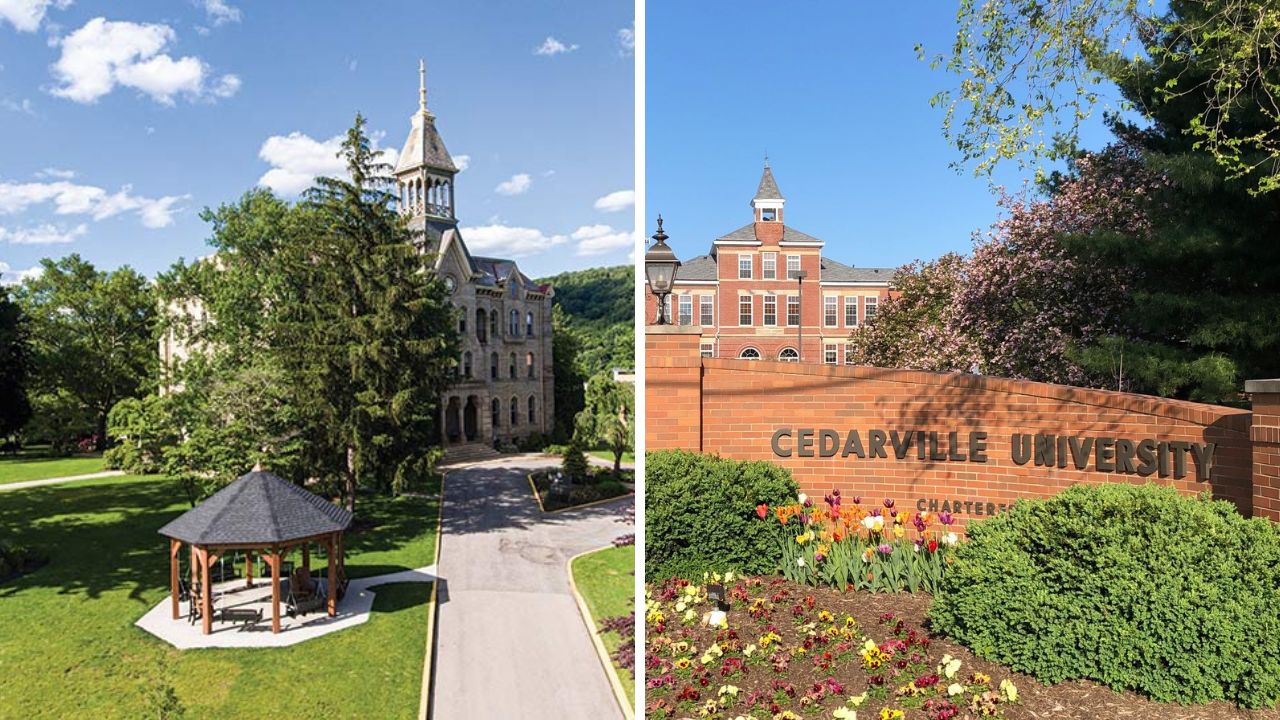
Cedarville-Geneva Partnership Strengthens Cybersecurity, Health Education for Students
Students and professionals pursuing a career in health care, higher education or cybersecurity now have a clearer path as the result of three new agreements between Cedarville University and Geneva College.

Julia Hart: For an Audience of One
Julia Hart ‘24, MAHE ‘26, set foot on Geneva’s campus in the fall of 2020, unsure of her path. Five years later, she's nearing the end of her master's program as a seasoned athlete with an unshakeable faith.

 Online Course Login
 myGeneva Student Portal

© Geneva College | All rights reserved